

Enterprises are slow to adopt genAI, despite all the discussion. There are many reasons for this hesitation, including risk, data complexity, ethical concerns, skill shortage, lack of education, limited exposure to tools, and uncertainty around use cases. One of the biggest challenges in that list is figuring out the best way to apply genAI, the use case. By identifying a strong use case, exploring the right tools, and making the business case, marketers can lead the way toward thoughtful genAI adoption.
Paving the way to adoption of GenAI is a bold, doer move.
To find your use case, find the friction.
As marketers, we probably already know where the friction points are in our programs, strategies, and tactics. That’s a great place to look for genAI use cases – real-world scenarios that connect AI’s capabilities to business value. Some key questions when evaluating use cases: Is the process data-driven, repetitive, or predictive? Would automation free up time for more ideation and creativity? Would it enable richer customer experiences? If so, it’s likely a strong candidate for genAI adoption.
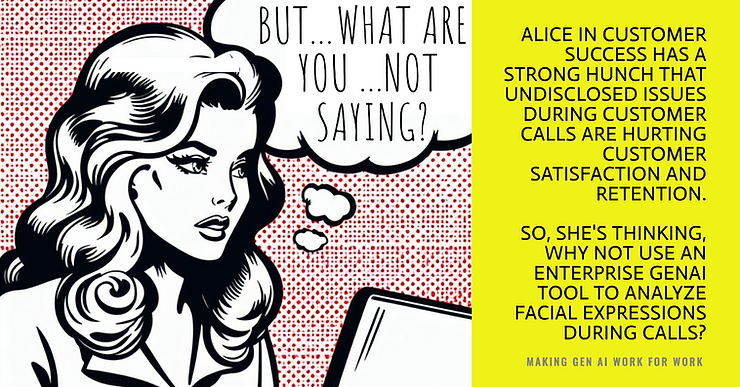
An AI use case in the vision category can analyze facial expressions to help gauge sentiment.
In marketing, speed helps, but results win.
The effectiveness of a marketing campaign isn’t simply judged by how quickly it hits the market, but by how it resonates with the audience, creating brand loyalty and boosting business growth. When looking for a use case for genAI, keep in mind that beyond speeding up a process or initiative only matters if it’s also creating a tangible impact.
Tie your use case to a business goal.
Tie your use case to a clear business goal, such as increased revenue or cost reduction. Use cases can be generally categorized into prediction, language, and vision. Prediction is about forecasting future outcomes. Language relates to generating or comprehending text. Vision involves analyzing visual content.
By strategically aligning a use case with business objectives, you can make a financially beneficial argument for genAI adoption. This advocacy is key to securing the resources needed to implement AI in a way that creates value.
Data is your fuel for AI.
AI needs good data to perform well and deliver value. So before implementing a genAI use case, be sure the data driving it is clean, organized, and relevant to the task at hand. High-quality data enables more accurate predictions, better task automation, and more actionable insights from your AI. We’ll dive deeper into data preparation in a future post.
It can be helpful to consider use cases in three categories.
The Marketing AI Institute has categorized use cases into prediction, language, and vision. Evaluating use cases in this framework can assist you in assessing various technologies, vendors, solutions, approaches, and models.
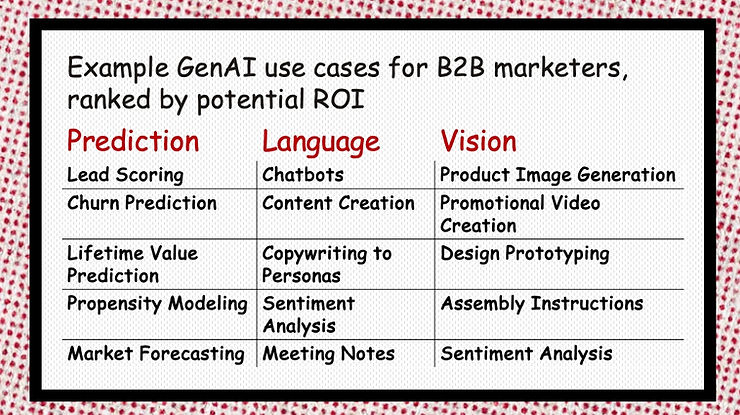
Ranking based on estimated revenue-generating potential, ability to drive efficiencies, and competitive differentiation.
AI has the potential to transform marketing teams into the very efficient, data-driven, and customer-centric organizations we aspire to be. By identifying your use case and strategically aligning it with business objectives, you can make a financially beneficial argument for adoption and advocate for the resources needed to implement it. This is an opportunity to impact the future of work. Find your use case.
About the graphic
Just like Roy Lichtenstein’s comic art bubbles visually express characters’ inner thoughts, genAI decodes subtle clues, revealing hidden sentiments in a discussion. It surfaces unsaid thoughts, helping to reveal what may lie beneath the surface of a conversation.
About me
As a B2B enterprise marketer, I’m on a quest to define our unique value proposition in the age of AI. I’m the writer and editor of The Strategist Blog, where I explore AI’s power to transform content creation and empower fellow marketers to shape the future of their work. That future is human-first, AI-powered. Let’s go!
More posts in this series
Making GenAI Work for Work: The ROI of REAL Connection
Making GenAI Work for Work: Create a Marketing AI Council
Making GenAI Work for Work: Nobody is Coming to Save You