

Even experienced teams with strong AI guidelines can encounter gaps between policy and daily practice.
This post explores eight AI governance blind spots communications leaders are encountering now and mentions a diagnostic worksheet to help you identify where your framework may need reinforcement.
Whether you’re drafting your first AI policy or evolving an existing one, a core leadership challenge goes beyond the document. It’s about navigating the subtle issues that impact your brand’s performance, team culture, and authentic voice. We’ve identified the following eight blind spots leaders tend to overlook.
1. The Investigative Journalist Blind Spot
Supporting judgment with process
Professional judgment is essential, but it can’t be the only line of defense against new AI risks such as algorithmic bias or data privacy issues. The most effective governance augments your team’s great judgment with a formal process, ensuring their skills are supported, not strained.
2. The “Perfect System” Fallacy
Letting the perfect be the enemy of the good
A blind spot emerges when the search for a perfect future system prevents you from implementing good-enough, manual processes today. While you wait, the essential “governance muscle memory” in your team isn’t being built. Adopting simple disciplines now, like tagging, reduces risk today and ensures your team is ready when the new tools arrive.
3. The Fear Factor
When your team is afraid to use AI
You’ve rolled out AI guidelines, but the blind spot is the unaddressed fear of breaking the rules or cheating. When your team is afraid to make a mistake, they will either avoid AI tools altogether or use them in the most basic, inefficient ways. This kills the very innovation and productivity you were hoping to gain.
4. The Stewardship Gap
When data responsibility is unclear
Your team knows to be careful with customer data, but the blind spot is ambiguity around the specific rules for AI. Clarity can be missing on who owns the data, what the team’s responsibility is for protecting it, and what the safe process is for actually using it. Governance defines those boundaries.
5. The Unmarked Starting Line
Forgetting to measure the “before”
In the rush to explore what AI can do, a fundamental first step is often missed: marking the starting line. Without a simple snapshot of the “before,” such as how long a task used to take or how many revisions it required, you can’t prove how far you’ve come. Your “after” story, no matter how compelling, remains an anecdote without a “before” to give it context and credibility. Even basic benchmarks, such as time, accuracy, or volume, are enough to show progress.
6. DIY Governance
Protecting your team in a silo
DIY approaches might work for a few projects, but they rarely scale and can create larger organizational risks. Effective governance is a shared effort. If that shared effort doesn’t exist yet, the blind spot is failing to see the opportunity to lead. Your most powerful move is to invite partners from legal, IT, security, privacy, and compliance to the table to build a practical playbook together.
7. The Novelty Trap
When a great tool doesn’t stick
A successful pilot creates a wave of excitement. The blind spot is assuming this excitement will change your team’s daily habits. Without a clear path to follow, people will revert to their comfortable old workflows, leaving the new tool as a novelty, not an essential capability. Governance provides the clear rules that give your team the confidence to use a better tool, not just a familiar one.
8. The Polished Façade
When content is correct, but hollow
Your review process is strong, catching the tangible errors. The blind spot is the harder-to-spot intangible: polished content that lacks genuine insight. This generic quality, a hallmark of unrefined AI output, makes your brand sound commoditized and erodes its unique point of view.
Want to strengthen your AI governance between policy and daily practice?
The AI Governance Blind Spot Diagnostic Worksheet helps you turn awareness into specific, defensible actions by identifying where your governance framework may not align with how work actually happens. Created by Expera Consulting, it reflects lessons learned from advising communications and marketing teams in regulated industries.
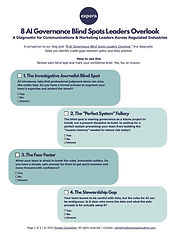
If you’d like a complimentary copy of the AI Governance Blind Spot Diagnostic Worksheet, reach out to me directly at catherine@experaconsulting.com, and I’ll send it your way.

About Me: I’m Catherine Richards, an AI strategist and the writer and editor of this blog. As Managing Partner at Expera Consulting, I help organizations in regulated industries use AI responsibly and effectively, bridging the gap between policy and daily practice.
With a background in cybersecurity, privacy, and regulation, my work centers on helping leaders and their teams build clarity and credibility in how they communicate about AI — and in how their teams actually use it.
Quick FAQ AI Governance and Blind Spots
What is AI governance in communications and marketing?
AI governance is the operational framework that bridges the gap between high-level policy and the daily workflows of your team. It’s not just a set of rules, but a living system of processes and responsibilities that ensures AI is used effectively, ethically, and in a way that protects and enhances the brand’s unique voice.
Why do blind spots in AI governance matter?
Blind spots matter because the risks aren’t just about compliance; they can be strategic. Unaddressed gaps can lead to a commoditized brand voice, kill innovation through fear, and erode customer trust by producing polished but hollow content.
How can I identify AI governance gaps in my team?
Start by observing any gaps between your written rules and your team’s daily reality. Are they afraid to experiment? Do successful pilots fail to scale? For a structured assessment, my AI Governance Blind Spot Diagnostic is designed to surface eight hidden gaps.
What should I do after identifying blind spots?
The goal is to turn awareness into action. After identifying a gap, the next step is to formalize a solution. This often means turning an informal process into a new standard operating procedure, creating a blameless review process for mistakes, or building the governance muscle memory through simple, repeatable disciplines.
How can communications and marketing leaders strengthen AI governance?
The most powerful move is to lead the cross-functional effort. As a steward of brand reputation, you are uniquely positioned to build the table, inviting partners from legal, IT, security, privacy, and compliance to co-create a single, defensible playbook. Governance succeeds when it is a shared effort you initiate, not a siloed document you create.